From sovereign-cloud advocacy to public-sector AI
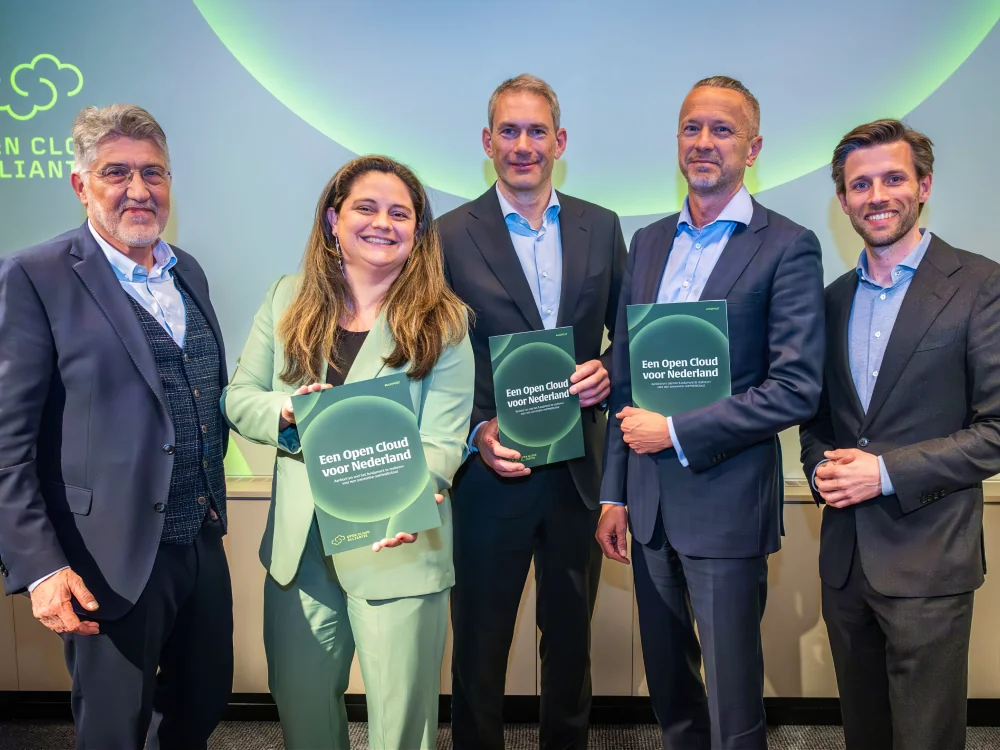
Three Nebul announcements outline a strategy that combines Dutch digital sovereignty, specialized government AI and more efficient inference infrastructure. Nebul says it joined six other Dutch providers in the Open Cloud Alliance, whose manifesto calls for sovereignty requirements in public procurement, open standards and migration of critical workloads to European-controlled platforms. In a separate initiative with Blueriq and Deloitte, Nebul supplies private European AI infrastructure and model-specialization capabilities for AI-assisted government objection handling, while professional case handlers retain final judgment. A technical collaboration with DDN and NVIDIA is meanwhile testing KV-cache acceleration and data infrastructure intended to improve GPU utilization, latency and inference economics. According to the announcement, the proof of concept has completed RoCE-based infrastructure validation and produced promising early time-to-first-token results, although no numerical benchmark data are disclosed.
Sovereignty is becoming an operational AI architecture
Taken together, the announcements suggest that Nebul wants to move sovereignty beyond data residency and turn it into an end-to-end operating model for AI. The emerging stack joins European jurisdiction and infrastructure control with open architectures, domain-specific model specialization, explainable decision logic and optimized inference. The Dutch government use case is especially revealing: Nebul is not positioning AI as an autonomous decision-maker, but as support for structuring submissions, checking completeness, summarizing files, finding relevant case law and drafting decisions. At the infrastructure layer, the emphasis is shifting from acquiring GPUs to obtaining more useful production output from them, measured through concepts such as cost per token, tokens per watt and time to first token. For the Netherlands and wider Western Europe, this combination reflects a broader strategic priority: operationalizing AI while retaining legal control, institutional accountability and a credible alternative to complete dependence on non-European hyperscalers.
Promising direction, but deployment evidence remains limited
The main limitations concern maturity, measurement and ecosystem dependence. The inference work is described as an ongoing proof of concept, and claims of improved efficiency or latency cannot be evaluated without baseline configurations, model details, workload profiles, energy measurements or independently reproducible results. Likewise, the objection-handling initiative offers a demo, whitepaper and blueprint, but the announcement provides no evidence of deployment at scale, user outcomes, error rates or impact on processing times. The Open Cloud Alliance’s statements that sovereign capacity already exists and that platforms can be deployed within weeks are provider claims rather than independently established findings. Buyers should also examine whether an architecture built around Nebul, NVIDIA and DDN creates new forms of technical concentration, and test portability, exit provisions, auditability, security controls and integration with existing public-sector systems. European jurisdiction can reduce some governance risks, but it does not by itself guarantee explainability, resilience or regulatory compliance.
Decision-maker conclusion from the Open Cloud Alliance announcement, inference collaboration and government AI initiative
For IT decision-makers in Western Europe, Nebul merits attention where sovereignty, sensitive Dutch-language workloads and accountable public-sector processes are primary requirements. Its direction is coherent across the selected sources: collective European cloud capacity in the digital-sovereignty initiative, production efficiency in the DDN and NVIDIA technical collaboration, and human-controlled implementation in the government objection-handling project. That alignment is strategically relevant, but procurement decisions should depend on workload-specific trials rather than positioning alone. Buyers should request transparent benchmark methods, contractual jurisdiction guarantees, model and data-governance documentation, evidence of interoperability and clearly defined human accountability. Nebul’s strongest proposition is therefore not sovereignty as an isolated label, but sovereignty combined with practical AI operations; the outstanding question is whether the collaborations can demonstrate repeatable performance and governance outcomes in live environments.
