Sovereignty expands from data location to the full technology chain
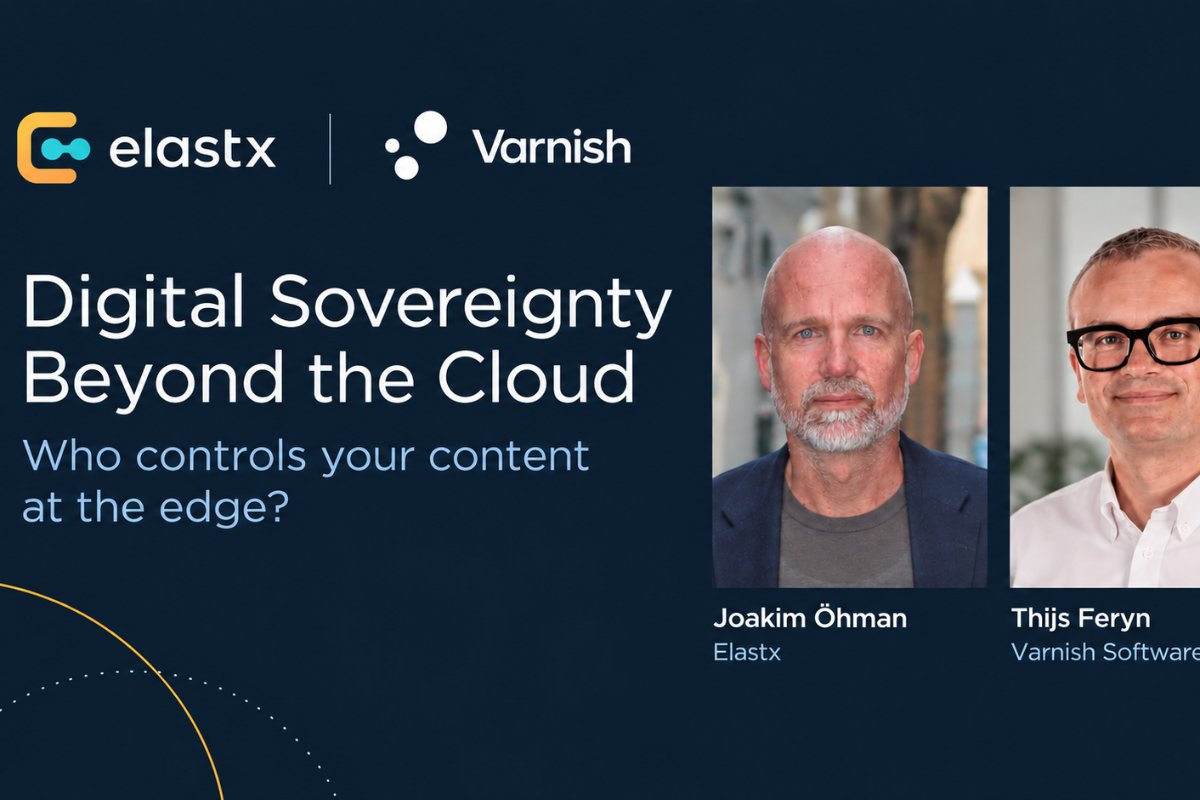
Three September 2026 articles present Elastx’s direction across cloud governance, edge infrastructure and software development. In its explanation of the EU Cloud Sovereignty Framework, Elastx argues that data-centre location alone does not establish sovereignty: ownership, jurisdiction, administrative access, operations, technology and supply-chain dependencies also matter. The provider reports a self-assessed Sovereignty Score of 87% and an overall SEAL 3 rating, while acknowledging that dependencies in areas including AI, operations, technology and supply chains prevent a higher level. A webinar announcement extends the same reasoning to CDNs and web application firewalls, which can terminate TLS, process traffic and protect applications between a cloud environment and its users. Separately, Elastx describes an internal shift towards AI agents that write, test and review software in isolated sandboxes. It says these agents can use documentation for technologies including OpenStack and Kubernetes, collaborate across codebases, and run both proprietary and open models such as Claude, Kimi and GLM. These are provider accounts and self-reported operational experiences rather than independently validated results.
Control, portability and AI operations are converging
The recurring strategic theme is control across the entire service chain. Elastx is positioning sovereignty not as a narrow data-residency feature but as an operating model spanning legal authority, privileged administration, edge delivery, AI models and development tooling. Its use of several models, including models hosted on its own hardware, indicates an attempt to reduce dependence on a single AI supplier’s pricing, availability and product direction. The same priority appears in its emphasis on open standards for CDN services and open-source cloud foundations. The emerging trend is therefore a convergence of sovereign cloud and agentic AI: model choice, execution location, access to source code and infrastructure documentation, and responsibility for generated output become procurement and governance questions. Elastx’s internal sandbox initiative and planned AI development environment also suggest that the provider sees AI infrastructure as a potential extension of its cloud platform, not merely as an employee productivity tool.
Ambitious claims still require operational proof
Several limitations matter for prospective customers. Elastx’s SEAL result is explicitly a self-assessment, and the article does not provide an independent audit, detailed scoring evidence or a complete mapping of residual dependencies. The provider also acknowledges that European control over processors, AI accelerators and other critical supply-chain components remains incomplete. Its AI productivity account is based largely on one developer’s experience; the claim that a pipeline formerly taking a month can be completed in a day is not accompanied by comparable project data, quality measures, cost analysis or long-term maintenance outcomes. Isolated agent sandboxes and human review are useful control concepts, but the selected material does not specify identity boundaries, model-data retention, incident handling, software-supply-chain controls or how customers could verify that generated code never bypasses release safeguards. Likewise, the edge-sovereignty article frames important questions about CDN and WAF jurisdiction without documenting a specific service architecture or measurable portability guarantees. Buyers should consequently treat the material as a statement of direction and evaluate each control contractually and technically.
Nordic decision guidance and sources: edge sovereignty webinar, SEAL self-assessment and agentic development account
For Nordic organisations, particularly those handling personal data, public services or critical workloads, Elastx’s direction is regionally relevant because it connects local operational control with broader European technology dependencies. Procurement teams should ask who owns and administers every layer, where privileged support and escalation occur, which jurisdictions can apply, how traffic is handled at the edge, and whether AI prompts, code and operational data leave the intended environment. They should also request evidence behind SEAL claims, identify non-European hardware and software dependencies, test model portability, and establish accountability for agent-generated changes. Elastx’s approach is strategically coherent, but suitability will depend on verifiable controls rather than sovereignty terminology or exceptional productivity anecdotes. The underlying provider material is available in the discussion of sovereignty beyond cloud infrastructure, the Cloud Sovereignty Framework and Elastx self-assessment, and the account of Elastx’s multi-model AI-agent environment.
