A combined focus on GPU usability, pricing and platform operations
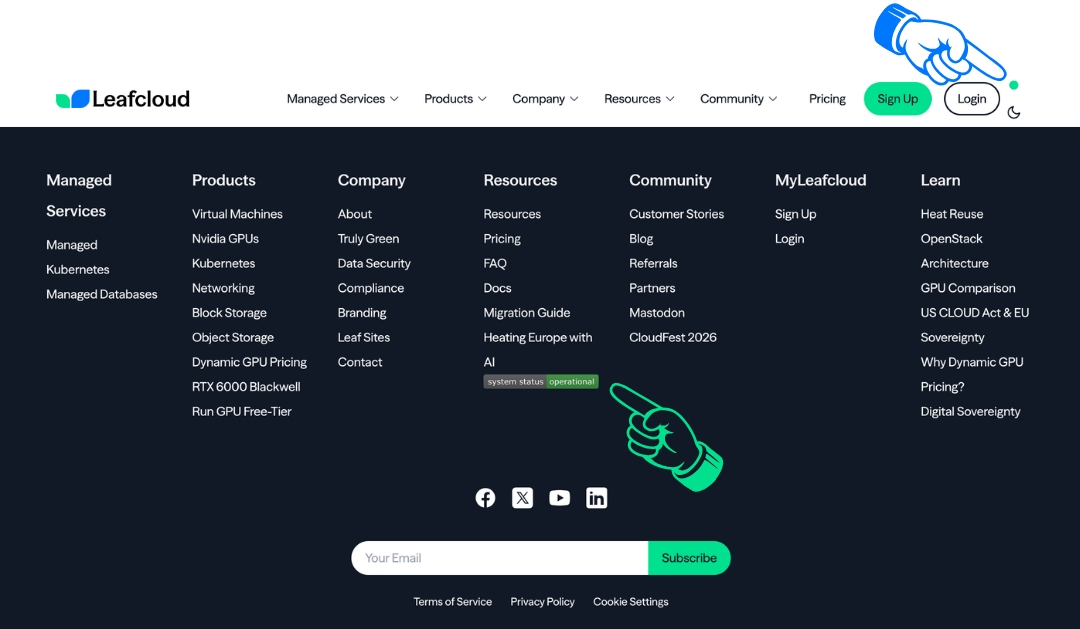
Leafcloud’s selected updates present three connected priorities. On operations, the provider says it has rebuilt the flow of incident alerts from monitoring systems to engineers and customers, while adding live status indicators, component-level reporting and incident history. On AI infrastructure, Leafcloud offers an approximate method for determining whether inference workloads fit within 24 GB of GPU memory, emphasizing model precision, context length, KV cache, batching and framework overhead. It is also promoting a free tier described as 50 monthly GPU-hours on a dedicated 24 GB slice of an RTX 6000. A separate pricing analysis recommends converting competing offers into an effective euro cost per GPU-hour while accounting for idle time, storage, egress, commitments and interruption risk. These product and pricing claims come from Leafcloud and have not been independently validated by CloudInsights.
Sustainable infrastructure is becoming part of the AI proposition
Taken together, the articles suggest that Leafcloud is positioning itself around accessible, comparatively small-scale AI inference rather than competing solely on maximum accelerator size. The 24 GB sizing guidance targets developers and organizations evaluating quantized language, transcription and image models, while acknowledging that larger models may require higher-memory hardware elsewhere. The strategic direction combines practical GPU access with an EU-hosted, open-source infrastructure proposition. Leafcloud says heat produced by inference is transferred to buildings that need hot water instead of being rejected through a cooling tower. For Western European buyers, particularly those examining Dutch sustainable-cloud options, this ties AI capacity to regional hosting and heat reuse. The status-system work adds another dimension: operational visibility appears to be treated as part of the service proposition, not merely as an internal engineering concern.
Important limits behind the positioning
The proposition still requires workload-level validation. Leafcloud explicitly describes its VRAM estimates as approximate: context length can materially expand KV-cache requirements, quantisation can affect model quality, and serving frameworks introduce different overheads. Its pricing framework is useful, but the comparison shown does not establish equivalent hardware, availability, service levels or workload performance across providers; free allowances can also obscure the cost once usage grows. The status update reports faster and more reliable notifications, but supplies no availability history, recovery-time figures or service-level evidence, and Leafcloud notes that automated degraded-state detection may be overly sensitive. Buyers should therefore assess performance, capacity availability, support, security requirements, contractual terms and the measurement of claimed sustainability benefits rather than relying on headline GPU-hour prices or model-fit tables alone.
Decision guidance and sources: Leafcloud’s status-system update
For Western European IT decision-makers, Leafcloud merits consideration where EU-hosted GPU inference, predictable 24 GB allocations and a sustainability-oriented infrastructure model align with the workload. It appears most relevant for experimentation, private-model evaluation and moderate inference jobs that fit on a single allocation; the provider itself concedes that spot capacity, free notebook services or larger cards can be better choices in other scenarios. A proof of concept should test real context lengths, concurrency, output quality after quantisation, end-to-end costs and incident handling. The source material consists of Leafcloud’s platform-status and alerting update, its 24 GB GPU model-sizing guide and its GPU pricing-normalisation analysis. Collectively, they indicate a coherent direction—practical AI infrastructure, clearer operations and regional sustainability—but not a substitute for technical benchmarking and contractual due diligence.
