Growth, infrastructure and product expansion converge
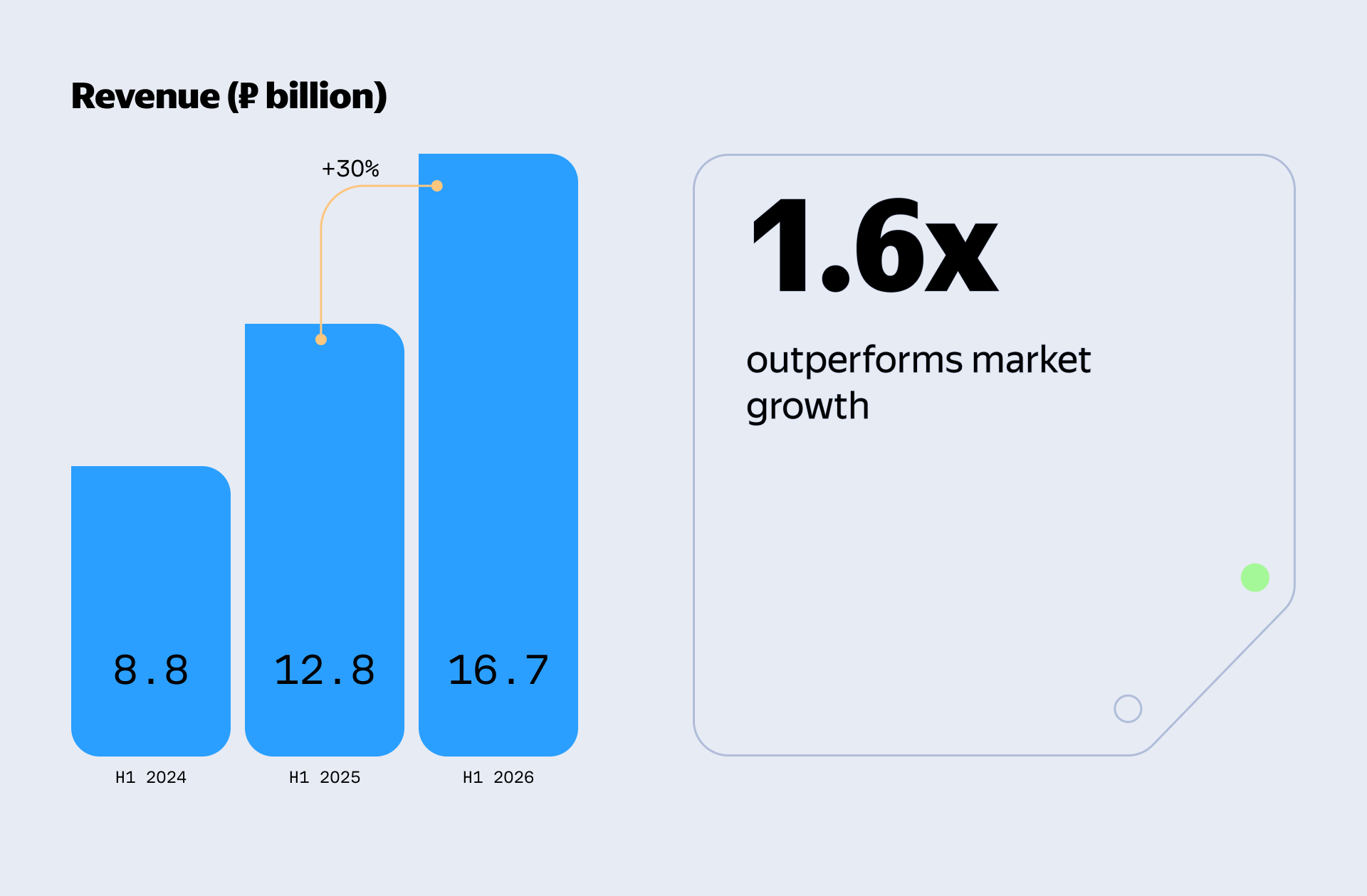
Yandex Cloud’s selected 2026 publications present a provider concentrating investment around artificial intelligence, security, data platforms and hybrid infrastructure. The company reports H1 2026 revenue of ₽16.7 billion, up 30% year over year, and says its client base increased 36% to 64,000. It also reports that large enterprises generated half of service consumption, while banking and fintech, retail and IT companies together represented 83%. Alongside these self-reported commercial results, Yandex Cloud launched the ru-central1-e availability zone, introduced the on-premises Stackland platform and previewed Cloud Router for connecting cloud, on-premises and bare-metal environments. AI Studio gained agent tooling, Code Interpreter, file search across additional media types, voice capabilities and SDK integration with SpeechKit. Security additions included Yandex SIEM, AI application protection, expanded DDoS and web application defenses, and vulnerability management. Kazakhstan appears as a targeted adjacent market: Cloud Registry and Message Queue became available there, documentation was added for Kazakh-language voice agents, and startups in Russia and Kazakhstan were included in the Cloud Boost program.
The emerging trend is a locally controlled AI operating environment
Taken together, the releases indicate that Yandex Cloud is moving beyond selling isolated infrastructure and model APIs toward providing a controlled environment for building, operating and securing enterprise AI. Agents connect to search indexes, files, Python execution, speech services and developer workflows, while Monium adds LLM observability and security products extend protection from code and infrastructure to AI applications. Stackland is strategically important in this pattern because it brings container, data, identity and AI workload management into customer-controlled infrastructure. This suggests that Yandex Cloud sees hybrid deployment not as an exception but as a central route to enterprise AI adoption, particularly for organizations that want local operational control or cannot place every workload in a public cloud. The Russia–Kazakhstan dimension is also visible at the product level: Kazakhstan receives selected cloud services and explicit Kazakh-language support, although the broader infrastructure expansion described in these articles remains centred on Russia.
Provider-reported momentum does not remove deployment risk
The financial, consumption and customer figures are Yandex Cloud’s own disclosures and should not be treated as independently verified market evidence. Several product statements also require validation in a buyer’s environment: the claimed cost reduction from Stackland is an estimate, benchmark assertions for AI models are not accompanied here by independent testing, and reported customer outcomes may not generalize to other architectures. Regional buyers should examine which services, support arrangements, data locations, commercial terms and resilience options are actually available in Kazakhstan rather than assuming parity with the Russian platform. Operational change is another consideration: the articles describe model URI changes, a Realtime API format transition and the retirement of the separate SpeechKit SDK, all of which can create integration work. Some capabilities were in preview, gated through support or newly released, so maturity, service levels, portability and exit planning deserve separate assessment. The selected material also provides insufficient comparative evidence to judge Yandex Cloud against alternative providers on total cost, performance or geographic reach.
Decision guide and sources: H1 2026 results, April product update and March product update
For IT decision-makers in Russia and Kazakhstan, Yandex Cloud merits evaluation where the priority is an integrated regional stack spanning infrastructure, managed data, AI agents, developer tooling and security, with the option to retain selected workloads on premises. Its direction is clearest for enterprises pursuing production AI while maintaining tighter control over data paths and deployment location. A practical assessment should nevertheless be country- and service-specific: verify Kazakhstan availability, architecture options, language support, contractual conditions, interoperability and the operational consequences of rapidly evolving APIs. Buyers should also run representative proofs of concept and compare independently measured cost, reliability and model quality rather than relying on provider-reported growth or case-study outcomes. The underlying evidence is available in Yandex Cloud’s financial and operating review for H1 2026, April 2026 product release summary and March 2026 infrastructure and product release summary.
