From infrastructure expansion to production AI
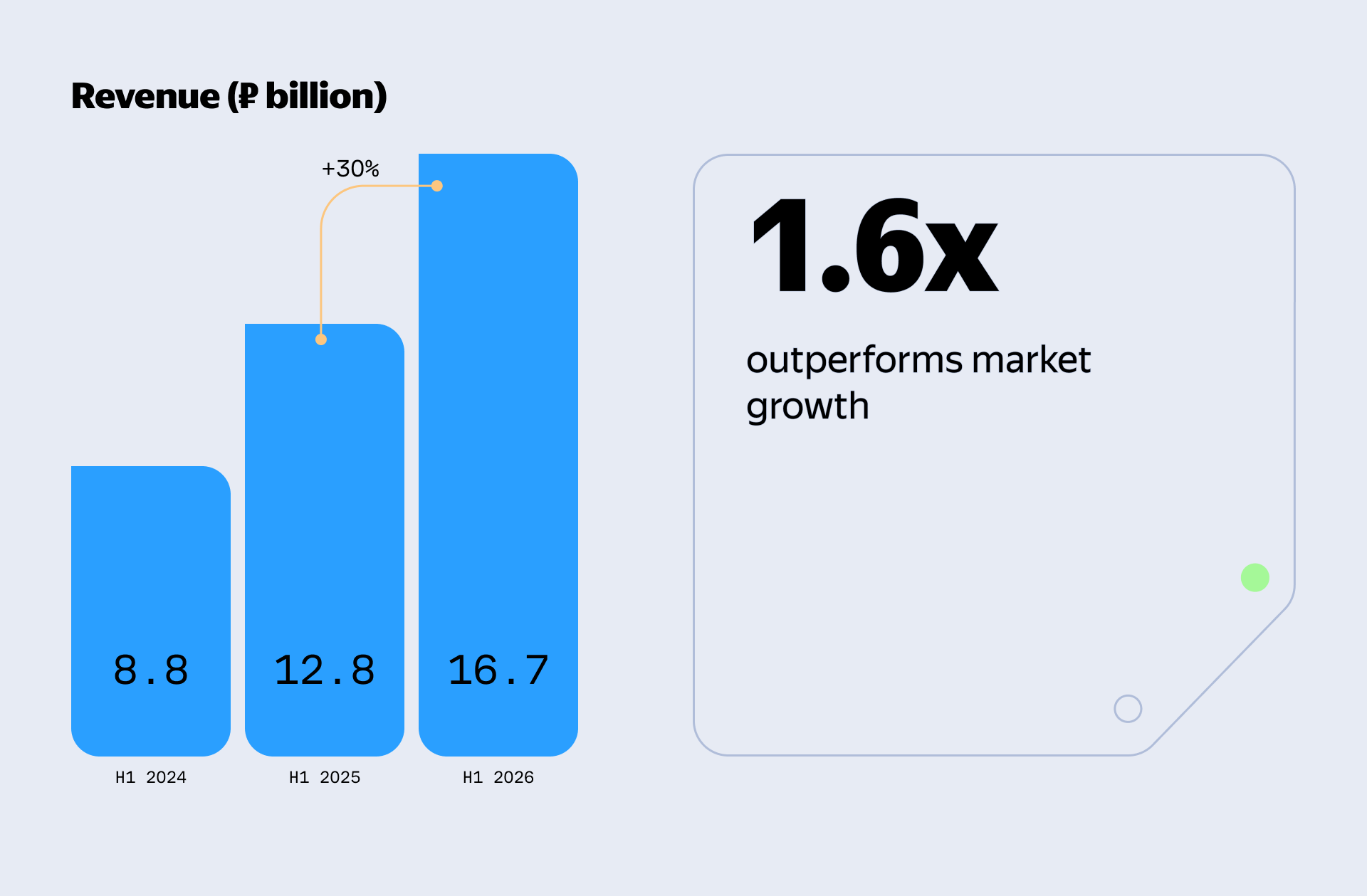
Across its March and April product updates and H1 2026 results, Yandex Cloud presents a consistent set of priorities: AI, information security, data platforms and hybrid infrastructure. The provider reports H1 cloud revenue of ₽16.7 billion, up 30% year over year, and 64,000 clients, up 36%; these are Yandex Cloud’s own figures and are not independently verified here. It also says IaaS generated 52% of revenue and PaaS 41%, while AI and security together represented 9%. Product activity supports the stated direction. Yandex Cloud launched its fifth Russian availability zone, ru-central1-e; introduced Stackland for deploying container, data and AI services on customer infrastructure; and previewed Cloud Router for linking cloud, on-premises and BareMetal environments. In AI, it expanded agent tooling, file search, voice services, Code Interpreter and SourceCraft’s coding assistance. Security additions included a cloud SIEM, AI application protection, vulnerability management and expanded DDoS and web-application defenses. Kazakhstan received narrower but explicit attention through the availability of Cloud Registry and Message Queue, Kazakh-language voice-agent guidance and startup support spanning Russia and Kazakhstan.
The emerging strategy is a locally integrated enterprise platform
The pattern suggests that Yandex Cloud is moving beyond a conventional public-cloud proposition toward an integrated technology stack that can operate across provider infrastructure and customers’ own environments. AI agents are becoming the connective layer: they appear in software development, analytics, voice interfaces and security operations, while data services, observability and governance supply the operational foundation. The provider’s reported 18-fold annual increase in commercial Yandex AI Studio API tokens and its claim that 37% of large enterprise customers use AI services indicate growing production use within its customer base, although token volume does not by itself demonstrate business value. Stackland, private endpoints, hybrid security monitoring and Cloud Router point to a parallel recognition that regulated or sensitive workloads may not move entirely into a public cloud. For Russia, the strategy is backed by a new domestic availability zone and an extensive managed-service portfolio. For Kazakhstan, the evidence indicates selective localization and language support rather than equivalent platform breadth. The regional trend is therefore not simply cloud migration, but adoption of AI and managed platforms under hybrid deployment, local-language and operational-control requirements.
Adoption advantages come with concentration and validation risks
Prospective customers should treat the reported growth, usage and performance figures as provider claims. The supplied articles do not provide audited segment accounts, independent service benchmarks, detailed service-level results or a complete comparison of Russian and Kazakh service availability. Some headline metrics also need careful interpretation: Yandex B2B Tech revenue combines Yandex Cloud with Yandex 360 and other activities, while large token counts, processed security events and created agents measure activity rather than application quality, return on investment or incident outcomes. The rapid pace of AI platform change introduces migration work as well: the articles describe model URI changes, Realtime API format changes and the end of maintenance for the separate SpeechKit SDK. A tightly integrated combination of AI Studio, SourceCraft, data services, identity and security may reduce integration effort, but it can also increase technical and commercial dependence on one ecosystem. Hybrid deployment mitigates some location and control concerns, yet adds responsibility for capacity planning, upgrades, security boundaries and consistent operations. Kazakhstan-based organizations should verify that every required service, support process, contract and dependency is locally available rather than inferring parity from a few announced launches.
Decision guide: H1 2026 results, April product updates and March product updates
For IT decision-makers in Russia, Yandex Cloud merits evaluation where local infrastructure, managed data platforms, production AI, security tooling and on-premises deployment must form one architecture. A proof of concept should test workload resilience across availability zones, AI output quality, token economics, security-event handling, API lifecycle management and the operational division between Yandex Cloud and the customer. In Kazakhstan, evaluation should begin with a service-by-service availability matrix and validation of Kazakh-language voice performance, data placement, support and integration requirements; the supplied evidence supports a growing presence, but not full equivalence with the Russian platform. Architecture teams should also preserve portability through open interfaces, export procedures and tested recovery plans. The provider’s strategic case is strongest as a regionally oriented hybrid AI platform, not merely as rented infrastructure, but procurement should tie that promise to measurable technical and business outcomes. The underlying provider statements and release details are available in Yandex Cloud’s H1 2026 financial and operating report, the April 2026 product digest and the March 2026 product digest.
