Growth claims align with a broad production platform build-out
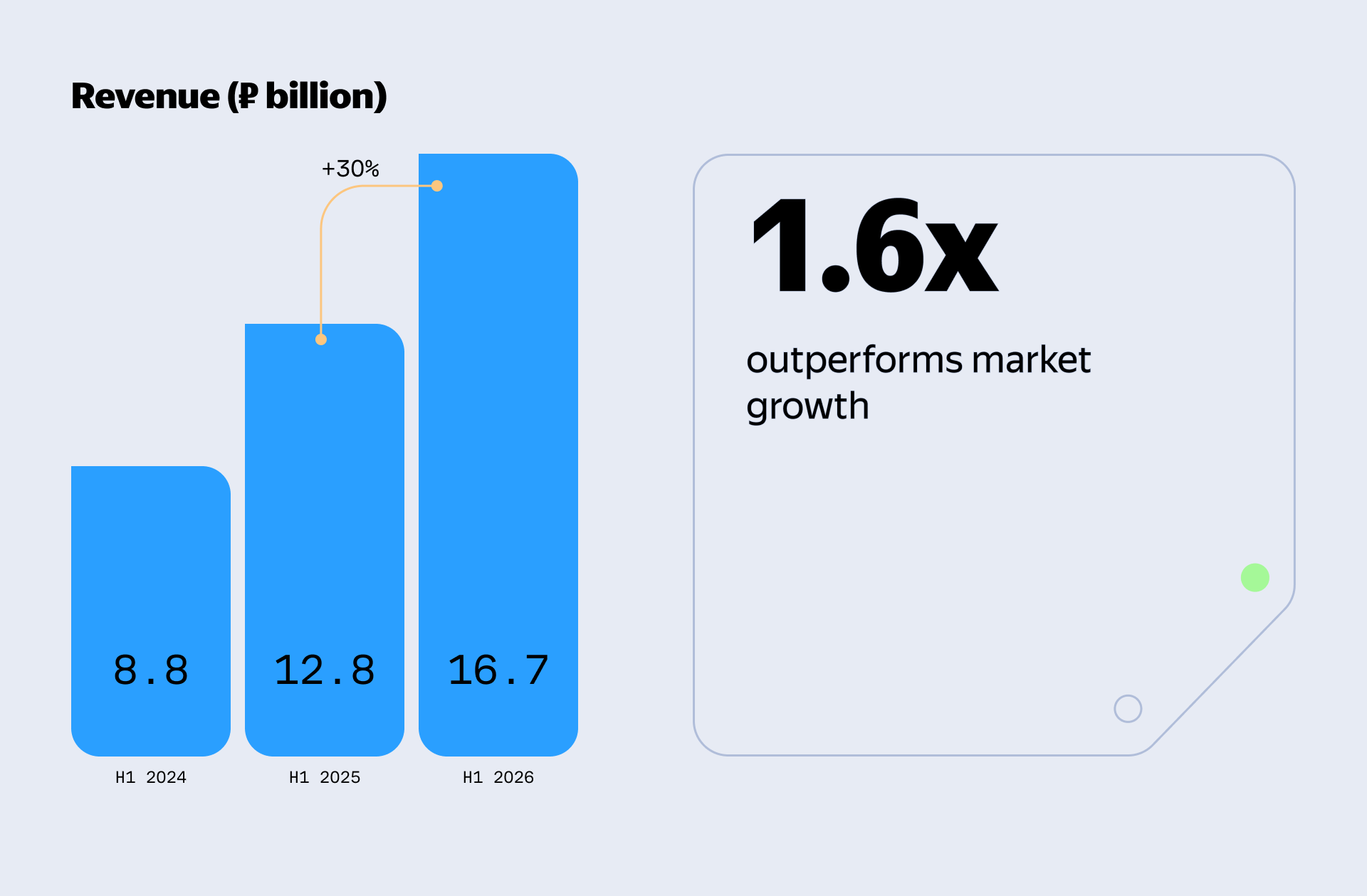
Yandex Cloud reports that its H1 2026 revenue reached ₽16.7 billion, up 30% year over year, while its client count rose 36% to 64,000. According to the provider, large enterprises generated half of service consumption, with banking and fintech, retail, and IT companies together accounting for 83%. Its product announcements support a shift beyond basic infrastructure: Yandex launched the on-premises Stackland platform, opened a fifth Russian availability zone, expanded managed data services, introduced a cloud-based SIEM, and added agent, voice, search, and code-execution functions to Yandex AI Studio. The company says 37% of its large-enterprise customers use AI services and 53% use its information-security services. Regional development remains concentrated on Russia but includes Kazakhstan: Yandex Cloud Registry and Message Queue became available there, its voice-agent documentation covers Kazakh, and the provider says startups in both countries received Cloud Boost grants.
The emerging model is sovereign-style hybrid AI rather than public cloud alone
The recurring strategic theme is the conversion of AI experiments into governed production workloads supported by data, security, developer tooling, and deployment choice. Yandex is assembling these elements into one operational stack: AI Studio supplies models and agent tools; SourceCraft embeds AI in software development; Monium adds LLM observability; Security Deck, Smart Web Security, Yandex SIEM, and SolidWall address infrastructure and AI-application risks; and Stackland takes selected cloud capabilities into customer-controlled environments. Our interpretation is that Yandex Cloud is positioning itself as a vertically integrated technology platform for organizations that want public cloud economics but require on-premises or hybrid operation. This is especially relevant to Russian enterprises with sensitive workloads. Kazakhstan appears to be the clearest adjacent market in the supplied material, although the evidence points to selective service localization and ecosystem support rather than an equally broad regional platform footprint.
Product breadth increases both opportunity and evaluation complexity
The figures, performance statements, customer outcomes, and market comparisons are provider claims and should not be treated as independently verified. The material does not provide comparable service-level, pricing, support, capacity, customer-adoption, or geographic data for Kazakhstan, nor does it establish availability elsewhere in Eastern Europe. Buyers should also examine product-lifecycle risk: the April update included required AI API and model-URI changes, consolidation of SpeechKit development into the AI Studio SDK, and notice of the Yandex Load Testing service’s closure. Stackland had reportedly been tried by more than 20 companies, which indicates early use but offers limited evidence of mature adoption at scale. Likewise, the newly introduced SIEM, AI-agent tooling, and hybrid networking capabilities require validation under each buyer’s workload, integration, governance, and recovery requirements. A wide integrated portfolio can simplify procurement, but it can also increase dependence on provider-specific interfaces and operational tooling.
Decision guide and sources: H1 2026 results, April product update, and March product update
For IT decision-makers in Eastern Europe, particularly those evaluating operations in Russia or Kazakhstan, Yandex Cloud merits consideration where local AI services, Russian cloud infrastructure, managed data platforms, and hybrid deployment are central requirements. Its direction is coherent: move AI into production, surround it with security and observability, and make core platform functions available across cloud and customer-controlled infrastructure. The strongest evidence concerns Russia; Kazakhstan has several concrete service and language signals but needs separate confirmation of service parity, support arrangements, data location, resilience, and commercial terms. A practical assessment should therefore compare public-cloud and Stackland architectures, test AI and security controls with representative data, document portability and exit procedures, and confirm every required service by deployment location. This assessment draws on Yandex Cloud’s provider-published first-half 2026 business and platform results, April 2026 product announcements, and March 2026 infrastructure and service announcements.
