Sandboxes, federated identity and production safeguards converge
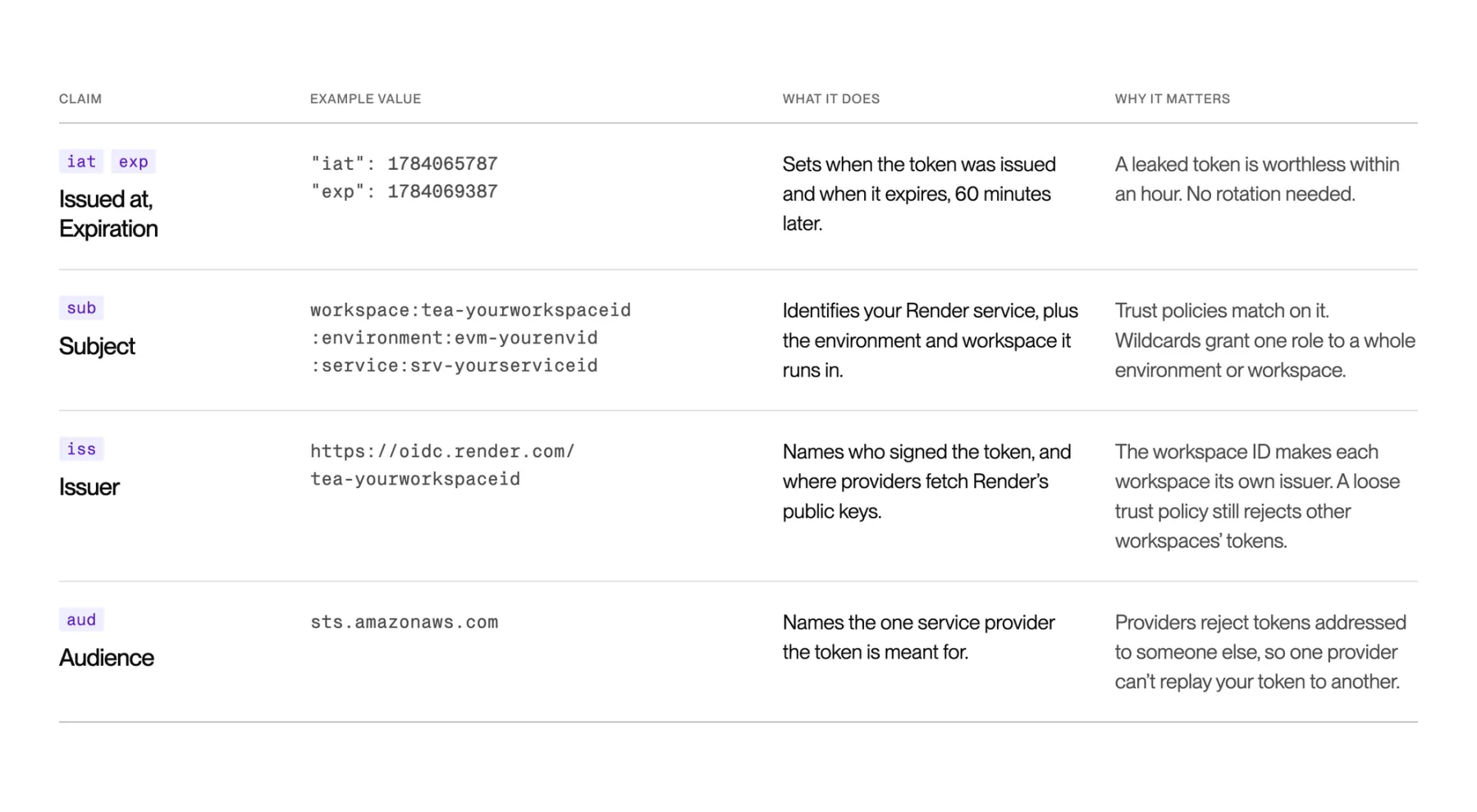
Render’s November 2026 announcements outline a broader PaaS proposition for AI-assisted software development. The provider launched Render Sandboxes in public beta as isolated Linux environments for agents, with each sandbox running in a Firecracker microVM and supporting TypeScript, Python and CLI management. Render says these environments can retain files, memory and processes through snapshots, suspend when idle, restrict outbound access and scale from one sandbox to thousands. The company also describes OIDC support for authenticating Render services to AWS, GCP, OpenAI and Anthropic without long-lived API tokens. Tokens expire after 60 minutes, are scoped through claims such as subject, issuer and audience, and are refreshed by a host-side daemon. Alongside these technical releases, Render defines production according to user dependency rather than deployment status and recommends risk-based controls covering releases, recovery, security, observability and testing. Collectively, these provider claims connect agent execution, workload identity and operational governance within one platform.
The emerging trend is an agent-aware PaaS control plane
The strategic direction is clear: Render is trying to make the PaaS control plane responsible not only for deploying applications but also for governing the transient computers and credentials used by software agents. Sandboxes address non-deterministic work that may continue for days, while Render Workflows remain positioned for repeatable steps. OIDC, credential brokering and scoped API keys address the corresponding identity problem by reducing the need to expose durable credentials to applications or agent-controlled environments. This supports a wider trend in which developer platforms must accommodate rapidly generated software without allowing deployment speed to substitute for production discipline. Render’s emphasis on automated suspension, short-lived identity, restricted egress and proportionate safeguards suggests that simplicity and security are intended to reinforce each other. For North American organizations, the Oregon launch location gives the product immediate regional relevance, but it also makes current infrastructure location an important architectural consideration.
Beta maturity, shared responsibility and regional limits remain material
The proposition has important limitations. Sandboxes are in public beta and currently available only in Oregon; private networking, additional regions, SSH access, public URLs, resource bursting and shared filesystems are described as future work rather than present capabilities. Credential brokering and scoped API keys are also in early access, so some of the strongest agent-security controls are not yet generally available. Render reports typical first-command readiness of under one second, runtime-snapshot startup improvements of three to ten times and experience provisioning isolated build environments more than one million times per day, but the supplied material does not provide independent benchmarks, availability results or large-scale customer evidence for Sandboxes. OIDC reduces exposure to long-lived secrets but does not remove configuration risk, application-level authorization requirements or dependency on token issuance. Render itself stresses that customers must still test failure behavior, select capacity limits, protect and restore data, configure useful telemetry and assign ownership. Buyers should therefore treat the platform controls as building blocks rather than proof that an agent-generated application is production-ready.
North American decision guide and sources: Render Sandboxes, Render OIDC and production readiness
For North American IT decision-makers, Render merits evaluation where teams want application services, databases, deterministic workflows and isolated agent execution under a common PaaS operating model. A proof of concept should verify Oregon placement against latency, residency and resilience requirements; test sandbox isolation, egress policy, snapshot recovery and cost behavior under realistic agent workloads; and confirm which early-access security features are actually available. Identity testing should include trust-policy boundaries, token renewal failures and least-privilege configuration across external providers. Operational acceptance criteria should follow the risk-based questions in Render’s assessment of production in agentic development, while technical validation can draw on the provider’s descriptions of isolated agent sandboxes and OIDC architecture. CloudInsights’ assessment is that Render is developing a coherent agent-aware PaaS strategy, but regional expansion, feature maturity and independently tested operating characteristics should determine whether it is suitable for production rather than experimentation.
