From cloud management to production AI operations
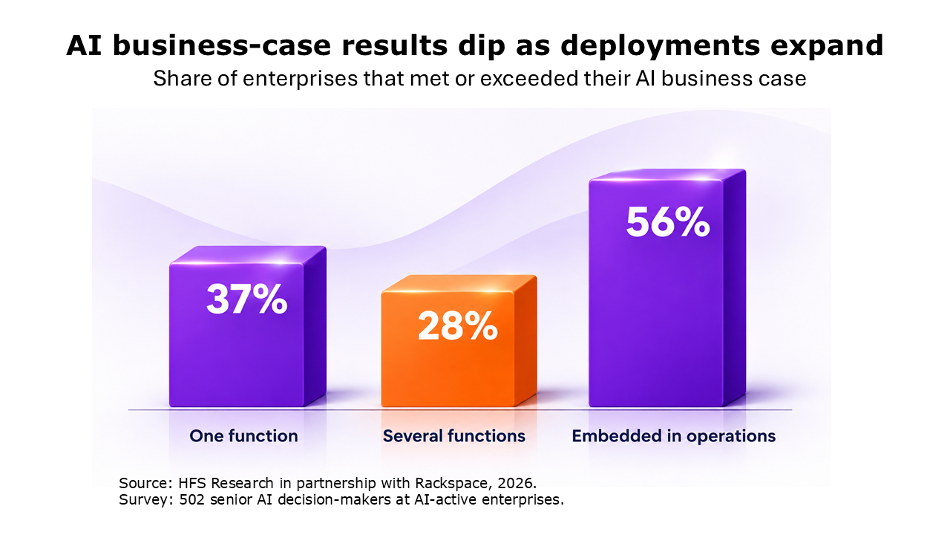
Three November 2026 announcements position Rackspace Technology’s managed multicloud strategy around operating AI and AI-adjacent workloads in production. A study conducted by HFS Research in collaboration with Rackspace surveyed 502 senior AI decision-makers across four regions. It reports that 33% had met or exceeded the business case for their most significant AI program, while 96% identified significant governance gaps. Rackspace uses these findings to argue for a single operator accountable for infrastructure, platforms, applications, data, costs and governance. Two commercial announcements illustrate that direction. Rackspace says it has an initial multiyear agreement to operate dedicated NVIDIA GB300 NVL72 infrastructure for Together AI’s inference workloads, with deployment planned for 2027 subject to financing and other conditions. A separate, non-binding letter of intent covers possible joint enterprise offerings. Rackspace also announced a multiyear agreement to provide Blacksmith with AMD EPYC-based compute and storage representing approximately 2 MW in Northern Virginia, with deployment expected to begin in early 2027. Together, the provider’s statements span GPU inference, CPU-intensive continuous integration, private and public cloud environments, and ongoing infrastructure operations.
Operational accountability is becoming the product
The emerging strategic theme is that Rackspace wants to compete less as a reseller of undifferentiated cloud capacity and more as an accountable operating layer across a heterogeneous AI stack. This is a logical extension of managed multicloud: enterprises may use different processors, models, platforms and deployment locations, but still need unified controls over performance, cost, security and governance. The Together AI agreement emphasizes dedicated accelerated infrastructure, liquid cooling, networking and storage for inference. The Blacksmith agreement highlights a related effect of AI adoption: faster code generation can increase demand for CPU-heavy testing and continuous integration rather than GPUs alone. Rackspace is therefore treating enterprise AI as a portfolio of connected operational workloads, not merely model training. Its preference for contracted dedicated capacity also suggests an effort to align expensive infrastructure commitments with identifiable demand. For North American enterprises, the Northern Virginia deployment gives this strategy concrete regional relevance, while the broader emphasis on regulated production environments, data control and flexible placement addresses concerns commonly associated with hybrid and multicloud estates. These are strategic signals and planned operating models, however, rather than proof of delivered customer outcomes.
Execution, financing and accountability remain tests
Rackspace’s thesis carries material execution risks. The planned Together AI deployment depends on acceptable financing, facility and equipment availability, power, and satisfaction of other contractual conditions; Rackspace stated that definitive GPU financing had not been obtained when the announcement was published. The potential joint go-to-market activity is covered only by a non-binding letter of intent, and any future security, compliance, sovereignty or residency characteristics would depend on specific offerings and customer arrangements. The Blacksmith capacity, timing and anticipated benefits are also forward-looking and exposed to procurement, financing, build-out and demand risks. Concentrating on dedicated capacity can improve demand visibility, but it also introduces hardware-lifecycle, utilization and partner-dependency questions. The HFS survey supports the contention that governance and fragmented accountability are obstacles among AI-active enterprises, but it was conducted in partnership with Rackspace, covers respondents across four regions without a North America-specific result, and does not demonstrate that using one managed operator causes higher returns. Buyers should consequently test Rackspace’s proposed accountability model through contractual service boundaries, cost attribution, audit rights, security controls, exit provisions and measurable production outcomes rather than relying on the strategic narrative alone.
North American decision guide: enterprise AI value study, Together AI infrastructure agreement and Blacksmith capacity agreement
For North American IT decision-makers, Rackspace is presenting a credible strategic direction: managed multicloud is expanding into managed AI operations, where the differentiator is responsibility for keeping diverse infrastructure and software components working as one production system. The relevant question is not simply whether Rackspace can supply NVIDIA or AMD capacity, but whether it can assume clearly defined operational responsibility across cloud, data, applications and AI while preserving customer control. Procurement teams should request evidence of completed deployments, operational service levels, governance processes, total-cost controls and workload portability. They should also separate committed capabilities from conditional plans and evaluate whether a single operator reduces coordination risk or merely adds another contractual layer. The provider’s HFS collaboration on AI accountability explains the business problem Rackspace wants to solve; the planned Together AI inference deployment shows its GPU-infrastructure ambition; and the Blacksmith agreement for Northern Virginia capacity extends the proposition into CPU-intensive software delivery. CloudInsights’ assessment is that this combination merits consideration for governed production AI, but final selection should depend on delivered operations, enforceable accountability and financing-backed capacity—not announcements alone.
