Capacity, pricing and a production-focused AI stack
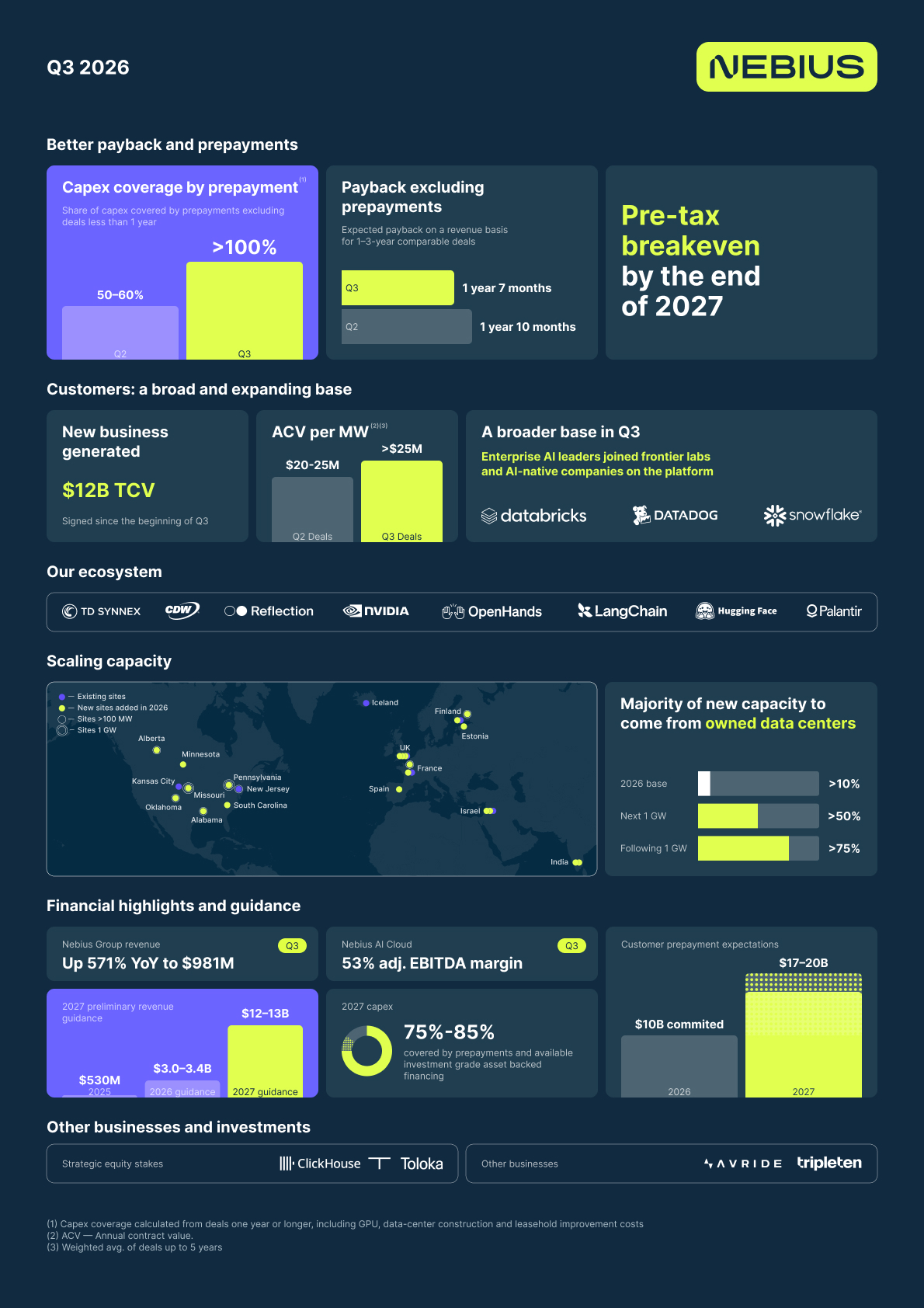
Nebius’s October and November 2026 announcements present three connected elements of its AI-cloud strategy. The Amsterdam-headquartered company says it is building a full-stack platform spanning data, model training and production deployment. It introduced public live spot pricing for preemptible GPU capacity alongside reserve auctions, pay-as-you-go access and a pilot program for returning idle GPUs to the spot pool. Nebius also reported a European capacity footprint covering Finland, France, the UK, Spain, Estonia and Iceland, while highlighting customers and research users in Germany, France, the UK, the Netherlands, Switzerland and Portugal. Separately, it announced a $3.5 billion, 364-day senior secured facility from Citi, intended for data-centre development, GPU procurement and general corporate purposes. Its third-quarter announcement confirms that unaudited results for the three and nine months ending September 30, 2026 were published, although the supplied webpage does not reproduce the key financial figures contained in the linked disclosure.
AI compute is becoming both a utility market and an integrated platform
The emerging direction is a combination of capital-intensive infrastructure expansion and more market-like consumption models. Public spot prices, auctions and capacity rebates suggest that Nebius wants GPU access to become more transparent and dynamically allocated rather than sold only through fixed reservations. At the same time, its emphasis on managed inference, ML-native tooling, physical-AI workflows and engineering support indicates that the company does not intend to compete solely as a capacity broker. Its close alignment with successive NVIDIA architectures points to early hardware adoption and hardware-software co-engineering as central differentiators. For Western Europe—and particularly the Netherlands—this creates a regionally anchored alternative for organisations that want training and inference infrastructure without defaulting to a conventional general-purpose hyperscaler. The Dutch examples cited by Nebius, Prosus and bunq, further show an effort to connect infrastructure with high-volume production workloads and open-model deployment, although their performance and cost results remain provider-published customer claims.
Execution, concentration and cost risks remain material
The strategy carries significant execution risk. Data-centre construction and GPU procurement require substantial capital, while the short maturity of the announced facility means refinancing, repayment or replacement funding will need careful management. Nebius itself identifies risks including additional capital requirements, unpredictable sales cycles, pricing pressure, competition, customer retention and the challenge of operating at the desired scale. Its technical direction is also strongly tied to NVIDIA platforms, creating potential concentration around one accelerator ecosystem even if that relationship accelerates access to new architectures. Spot instances can improve flexibility but are preemptible, so they will not suit every production or tightly scheduled training workload. The announcements do not provide independently comparable Western European pricing, service-level commitments, energy data, data-residency detail or a breakdown of deployed capacity by location. Several efficiency, throughput and customer-cost statements are presented by Nebius or named customers rather than established through evidence included in the supplied articles.
Decision point for Western Europe — Nebius’s European compute announcement
For IT decision-makers in Western Europe, Nebius merits evaluation where GPU availability, transparent short-term pricing, open-model workloads and access to newer NVIDIA systems matter. Its Amsterdam base and stated European footprint are regionally relevant, while its financing plan indicates an intention to expand beyond a niche capacity position. Buyers should nevertheless validate actual availability in the required location, interruption policies, contractual service levels, data governance, networking and storage charges, portability, support arrangements and total workload cost. A proof of concept should compare stable reserved capacity with spot economics under realistic training and inference demand, rather than relying on headline prices or provider case studies. The underlying evidence is available in Nebius’s European pricing and AI-builder announcement, its Citi financing-facility announcement and its third-quarter 2026 results notice. Together, they support the assessment that Nebius is pursuing a vertically integrated, NVIDIA-centred AI cloud with flexible compute markets, but they do not by themselves establish comparative leadership or long-term operational economics.
