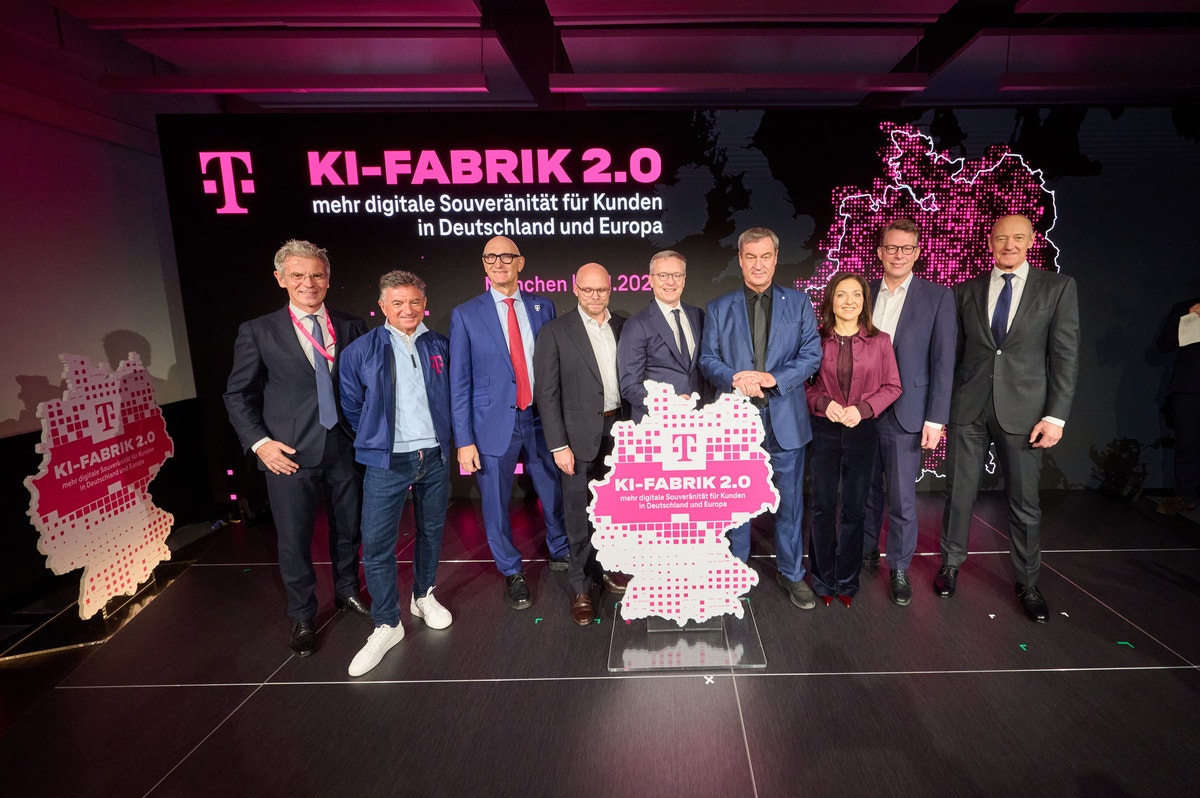
Munich AI capacity grows as network operations become more circular
Deutsche Telekom says it will expand its Industrial AI Cloud in Munich to 20 megawatts, adding NVIDIA Blackwell Ultra B300 systems alongside existing B200 and RTX PRO 6000 infrastructure. According to the provider, the first phase was fully booked seven months after opening in February 2026, with users applying the capacity to industrial AI, robotics, simulations, digital twins and language models. The expansion coincides with reported commercial momentum at T-Systems: Deutsche Telekom’s third-quarter release says Systems Solutions order entry reached €883 million, up 27.7 percent year on year, with the strongest growth in Industrial AI Cloud. Separately, the group is extending infrastructure resilience through its Telekom Equipment Exchange, which allows national companies to transfer surplus network components internally. Deutsche Telekom cites exchanges involving operations in Austria, Poland, Greece, Slovakia and North Macedonia and says reused equipment can cost up to 80 percent less than new equipment, depending on the component.
A strategy built around industrial AI, sovereignty and operational scale
Taken together, the announcements indicate that Deutsche Telekom is positioning AI infrastructure as an extension of its established connectivity and enterprise-services role rather than as an isolated public-cloud offering. The Munich facility emphasizes production-oriented workloads and European requirements for security, data protection and control, while partnerships and named users connect the platform to Germany’s industrial base. The equipment exchange reflects the same strategic logic at an operational level: use group scale, shared processes and cross-border inventory to reduce procurement delays and dependence on scarce legacy components. For Western Europe, the emerging trend is a combination of concentrated sovereign AI capacity in Germany and increasingly coordinated infrastructure operations across national subsidiaries. Deutsche Telekom’s reported European revenue and adjusted EBITDA AL growth provides financial context for that direction, although the group’s overall results remain strongly influenced by T-Mobile US.
Capacity claims do not yet answer every procurement question
The evidence is promising but largely provider-reported. Full booking and higher order entry indicate demand, yet the releases do not disclose customer concentration, contract duration, pricing, utilization by workload or the profitability of the Industrial AI Cloud. Nor do they provide comparative performance data against hyperscalers or other European AI infrastructure providers. Reliance on NVIDIA systems may deliver access to current accelerator technology while also creating hardware, software and supply-chain concentration. The planned 20-megawatt footprint makes energy availability and operating efficiency material considerations: Deutsche Telekom reports a PUE of 1.2 and plans to reuse waste heat, but supplies no independently validated measurements or absolute energy and emissions data. Further expansion in Bavaria has not received a final investment decision and depends on financing and economic viability. The equipment-reuse initiative also remains subject to compatibility documentation, licensing, maintenance, customs and regulatory work, which may limit how quickly it can scale across different national networks.
Decision point and sources: Munich AI factory expansion, third-quarter results and network-equipment reuse
For Western European IT decision-makers, Deutsche Telekom merits consideration where data control, proximity to German industry, production-scale AI workloads and integration with managed infrastructure are more important than access to the broadest possible global cloud portfolio. Buyers should validate available accelerator capacity, workload portability, contractual allocation of scarce resources, data-location commitments, operational support and total cost before treating the Munich expansion as equivalent to a mature hyperscale service. They should also ask how circular hardware practices affect maintenance status, vendor support and service-level commitments. The provider’s direction is coherent: invest in sovereign industrial AI while making the underlying telecom estate more resilient and resource-efficient. However, procurement decisions should separate that strategic narrative from demonstrated service economics and workload outcomes. The assessment is based on Deutsche Telekom’s announcements covering the Industrial AI Cloud capacity expansion, its Q3 2026 financial and operating performance, and the Telekom Equipment Exchange initiative.
