Sandboxes, federated identity and production safeguards converge
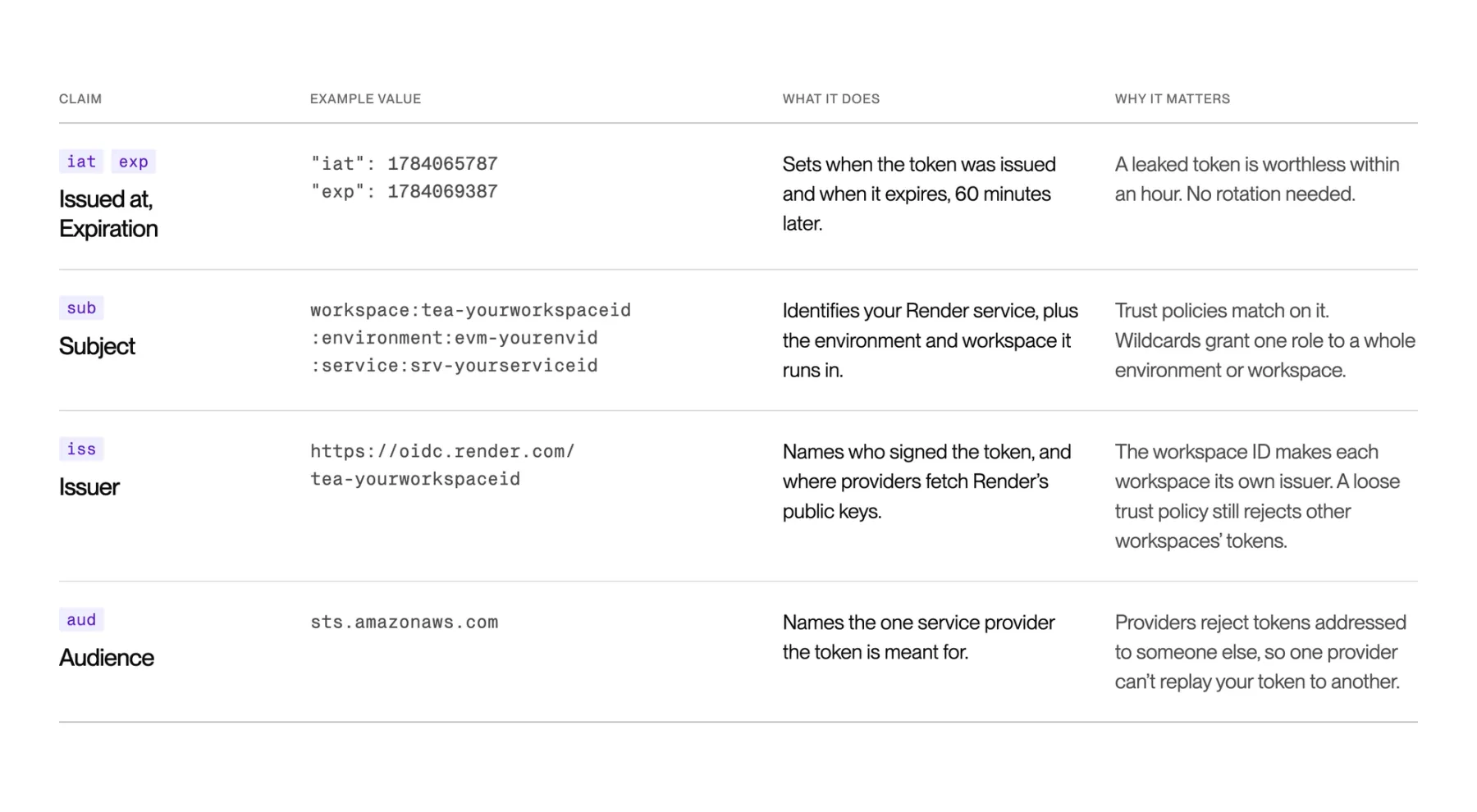
Render’s November 2026 announcements extend its PaaS proposition into infrastructure for agentic applications. The provider launched Render Sandboxes in public beta, describing them as isolated Linux environments based on Firecracker microVMs that can run agent-generated code, retain state through filesystem or runtime snapshots, and suspend when idle. Render says the service supports TypeScript and Python SDKs, its CLI, configurable outbound-network policies and usage-based CPU billing. Sandboxes are initially available only in Oregon, with private networking and additional regions listed as future work. Separately, Render says its new OIDC support allows services to authenticate to AWS, GCP, OpenAI and Anthropic with short-lived, provider-specific tokens rather than long-lived API credentials. A third article sets out Render’s view that software becomes production software when users or systems depend on it, emphasizing deployment recovery, failure handling, data protection, observability, testing and operational ownership regardless of whether humans or agents wrote the code.
The emerging strategy is a managed control plane for agentic software
Taken together, the releases indicate that Render wants to remain the abstraction layer between developers and infrastructure as AI changes how applications are created and operated. Sandboxes address non-deterministic work by giving each agent or task an isolated, stateful runtime, while Render Workflows are positioned for repeatable steps. OIDC, credential brokering and scoped permissions address the corresponding identity problem: agents and applications need access to external services without receiving broadly reusable secrets. Render’s production-readiness guidance completes that direction by arguing that faster code generation must be matched by risk-based operational controls. The strategic trend is therefore broader than adding AI integrations to a conventional PaaS. Render is moving toward a platform where execution isolation, identity, deployment and governance are managed together, reducing the amount of infrastructure that development teams must assemble themselves.
Beta status and operational boundaries require careful evaluation
The current proposition has material limitations. Render Sandboxes remain in public beta and are confined to Oregon; private networking, wider regional availability, SSH access, public URLs, resource bursting and shared filesystems are described as forthcoming rather than current capabilities. Credential brokering and scoped API keys are also in early access. Render reports that sandboxes are typically ready for an initial command in under one second, that runtime snapshots can improve startup by three to ten times, and that its platform already creates isolated build environments more than one million times daily, but the supplied material does not provide independent benchmarks or production service commitments for the new product. OIDC reduces dependence on long-lived secrets, yet its 60-minute token lifetime introduces reliance on Render’s continuing ability to refresh credentials, and organizations with multiple workspaces must configure trust separately. Buyers should also validate pricing behavior, workload isolation, incident response, compliance, data residency, network controls and recovery procedures against their own requirements rather than treating platform defaults as a complete production-readiness model.
North American buyer guidance from Render’s Sandboxes launch, OIDC engineering account and production-readiness analysis
For North American IT decision-makers, Oregon availability gives Render’s agent runtime immediate regional relevance, but it also creates a single-region constraint for organizations that need geographic redundancy, specific data locations or lower latency elsewhere in the region. The strongest near-term fit is likely to be development teams already using Render that want to experiment with coding agents, software factories or support automation without operating a separate sandbox platform. A sensible evaluation should test isolation, snapshot restoration, outbound restrictions, credential handling, cost during active and suspended periods, and failure recovery under realistic workloads. Render’s public-beta Sandboxes announcement establishes the runtime direction, its explanation of OIDC implementation shows how it is simplifying cross-cloud identity, and its production-readiness guidance acknowledges that rapid deployment does not remove operational responsibility. The combined direction is credible as a PaaS evolution, but North American enterprises should treat Sandboxes as an emerging capability and require evidence from their own proof of concept before placing business-critical agent workloads on it.
