From cloud management to production AI infrastructure
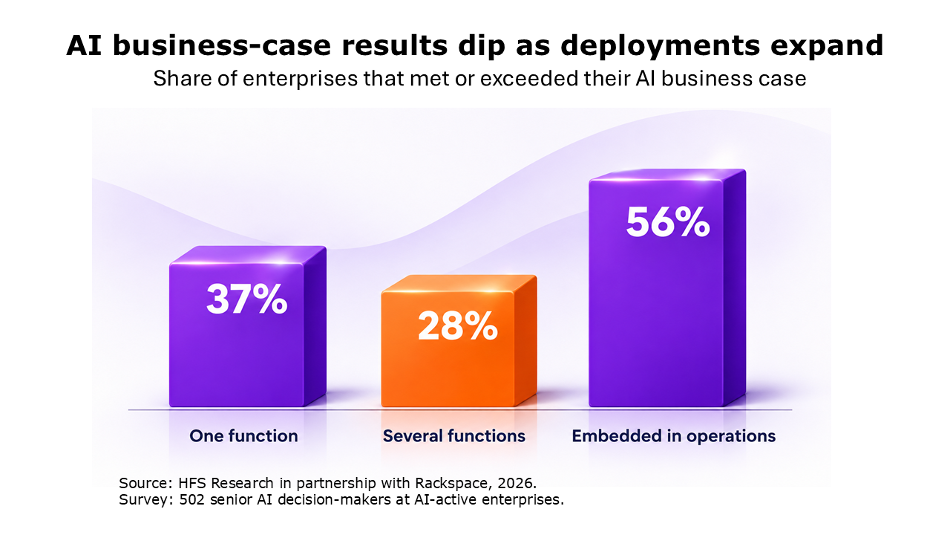
Three Rackspace announcements position operational accountability as the connecting layer between AI infrastructure and business outcomes. A study conducted by HFS Research in collaboration with Rackspace surveyed 502 senior decision-makers at AI-active enterprises across four regions. It reports that 33% had met or exceeded the business case for their most significant AI program, 96% identified significant governance gaps and 44% lacked a consistent approach to running AI in production. Separately, Rackspace announced a multiyear agreement under which it expects to operate dedicated NVIDIA GB300 NVL72 infrastructure for Together AI, with deployment planned for 2027 subject to financing and other conditions. It also announced an agreement to provide Blacksmith with AMD EPYC-based compute and storage representing approximately 2 MW in Northern Virginia, expected to begin deployment in early 2027. Together, these provider-published statements connect governance, accelerated inference and CPU-intensive software testing to Rackspace’s stated ambition to operate infrastructure, applications, data and AI across private and public cloud environments.
Managed multicloud is becoming an AI operating model
The emerging trend is a shift from managing separate clouds toward assuming responsibility for the operation of an integrated AI system. Rackspace is presenting governance, cost control, security, engineering and infrastructure availability as interdependent production concerns rather than isolated services. Its proposed role sits between raw capacity and business applications: operating dedicated hardware while coordinating platforms, models, data and controls across customer-selected environments. The Together AI agreement emphasizes inference and governed production deployments, while the Blacksmith arrangement shows that Rackspace sees AI demand extending beyond GPUs into CPU-heavy testing and continuous integration. The common commercial pattern is also notable: dedicated capacity supported by multiyear commitments, with Rackspace seeking to align financing and capital expenditure with expected demand. For North American organizations, the planned Northern Virginia capacity provides a concrete regional element, although the supplied articles do not establish broader geographic availability or service levels.
Execution, financing and accountability remain open tests
The strategy carries material execution risks. The Together AI deployment is planned rather than operational, Rackspace had not secured definitive financing for the NVIDIA systems when it issued the announcement, and the related joint go-to-market letter of intent is non-binding. Facility, power, liquid-cooling, equipment and networking availability could affect delivery. The Northern Virginia deployment for Blacksmith is likewise forward-looking and dependent on infrastructure procurement, financing and customer demand. The HFS findings support the importance of governance and unified responsibility, but they describe AI-active enterprises rather than market-wide adoption; they also do not prove that appointing one operator causes stronger returns. Rackspace has not supplied independently validated performance, cost, availability or customer-outcome data for these planned environments. Buyers should therefore distinguish the useful operating-model argument from evidence that Rackspace can deliver measurable results at the proposed scale.
Decision guide and sources: enterprise AI accountability study, Together AI agreement and Blacksmith infrastructure agreement
For North American IT decision-makers, Rackspace merits consideration where the problem is not simply obtaining cloud capacity but coordinating dedicated infrastructure, public and private cloud choices, governance and continuous operations under clearer accountability. Its direction is especially relevant to regulated or production-sensitive workloads that require control over placement, data and technology choices. Evaluation should nevertheless be tied to contractual milestones: confirmed financing and deployment dates, capacity guarantees, operating responsibilities, security and compliance controls, cost transparency, exit provisions and measurable business outcomes. Buyers should compare the claims in the HFS Research and Rackspace study announcement with the conditional commitments described in the Together AI infrastructure announcement and the regional capacity details in the Blacksmith agreement announcement. The strategic proposition is coherent: managed multicloud is evolving into managed AI operations. The investment decision should depend on whether Rackspace converts that proposition into deployed capacity and verifiable operational outcomes.
