A proposition built around visible operations and right-sized AI infrastructure
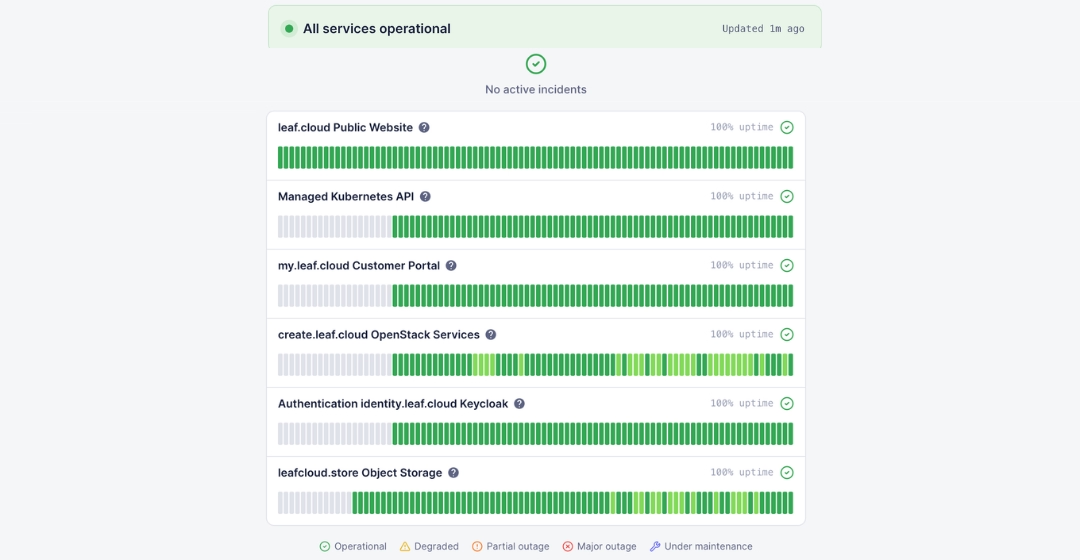
Leafcloud’s selected updates combine three elements of its emerging cloud proposition: platform transparency, practical GPU sizing and comparable pricing. The provider says it has rebuilt parts of its incident-alerting flow, added live status indicators and refreshed its status page with component information and incident history. For AI workloads, Leafcloud presents a method for estimating whether models can run on a 24 GB GPU allocation, while stressing that context length, batching, quantisation and framework overhead affect the result. It is also promoting a waitlisted free tier that, according to Leafcloud, provides a dedicated 24 GB slice of an RTX 6000 for 50 GPU-hours per month. The provider positions this infrastructure as EU-hosted, based on an open-source stack and installed in buildings where server heat can be used for hot water rather than rejected through a cooling tower.
Sustainable cloud is becoming an operational AI proposition
The strategic direction is broader than environmental positioning alone. Leafcloud appears to be translating its sustainable-cloud identity into a practical offer for private inference, experimentation and other modestly sized GPU workloads. Its emphasis on VRAM rather than abstract compute units suggests a focus on buyers who need to determine whether a specific model will actually fit. The pricing guidance follows the same pattern: Leafcloud recommends converting offers to an effective euro cost per GPU-hour while accounting for idle time, storage, egress, commitments and interruption risk. Taken together, these themes point toward a differentiated Western European proposition based on understandable capacity, local relevance, operational visibility and heat reuse. That could appeal to Dutch and nearby European organisations that value cost control and sustainability alongside access to AI infrastructure, although the supplied articles do not establish the scale of demand or availability.
A clear niche, but workload fit and service maturity still require scrutiny
The proposed 24 GB allocation is not universal infrastructure. Leafcloud’s own examples indicate that larger models such as Mixtral 8×7B and Llama 3.3 70B do not fit within that capacity under the configurations discussed, while some smaller models become constrained by long contexts or batching. Quantisation can reduce memory requirements, but Leafcloud also acknowledges that fitting a model does not mean it performs identically and that framework overhead varies. Its free GPU tier was described as a waitlist offer, so buyers should confirm current availability, paid pricing, service terms and production support. Likewise, faster alerting and a clearer incident history are useful operational signals, but they do not by themselves demonstrate availability levels, recovery performance or long-term reliability. Decision-makers should therefore validate workload benchmarks, data-residency details, security controls, networking, egress costs and service commitments before treating the offer as production-ready.
Decision guide: Leafcloud’s status update, 24 GB sizing guide and GPU pricing method
For IT decision-makers in Western Europe, Leafcloud is most relevant where sustainability requirements intersect with private or experimental AI workloads that fit within a 24 GB GPU envelope. Its combination of heat reuse, EU hosting, transparent status reporting and workload-level cost reasoning is coherent, but it should be assessed as a focused proposition rather than a substitute for every GPU-cloud use case. A sensible evaluation would use Leafcloud’s model-memory guidance to define a representative test, apply the cost factors in its GPU pricing normalisation article, and examine incident communication through the platform status update. Buyers should then compare measured model quality, latency, effective hourly cost and operational terms against alternatives. Leafcloud’s direction is noteworthy for the Dutch sustainable-cloud market because it connects environmental design to a concrete AI service, but procurement should remain grounded in workload testing and contractual evidence.
