Public-sector cloud and SME AI shape the 2026 agenda
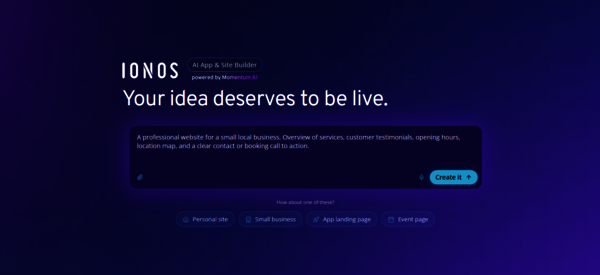
IONOS Group’s 2026 communications point to a portfolio built around sovereign digital services, applied AI and operational assurance. The provider says govdigital eG selected IONOS as general contractor for a cross-state school cloud serving six German federal states, with responsibility for setup, migration and operation. It also announced an AI App & Site Builder aimed at small and medium-sized businesses, while the IONOS Momentum initiative is positioned as an AI ecosystem for businesses and the public sector. The proposed Euro-Office initiative adds a European, open-source-based alternative to Microsoft Office. IONOS further cited an IONOS and YouGov study reporting that two-thirds of German SMEs view AI positively, while more than half fear their data could reach the US or China. Separately, the group stated that websites and hosting operated by its brands were protected following disclosure of two critical PHP vulnerabilities. Its investor announcements also reference a strategic transformation programme, successful 2026 trading updates and record profitability for 2025, although the supplied summaries do not provide the underlying figures or programme details.
Sovereignty is becoming the connective layer rather than a standalone feature
Taken together, these initiatives suggest that IONOS wants sovereignty to connect infrastructure, productivity software, AI tooling and managed operations. The strategic direction is not limited to offering European-hosted compute: IONOS is presenting itself as a general contractor for public-sector workloads and as an application provider for SMEs that may lack specialist development teams. The AI App & Site Builder indicates an emphasis on lowering the barrier to software creation, while Momentum suggests a broader ecosystem approach. Euro-Office extends the proposition into workplace applications, where dependence on non-European vendors is an increasingly visible policy and procurement concern. For Western Europe, that combination is relevant because data jurisdiction, supplier control and compatibility with established tools often matter alongside price and functionality. The school-cloud contract also points toward greater operational responsibility, including migration and ongoing service delivery. Strategically, IONOS appears to be pairing this expansion with an internal transformation programme, implying that portfolio growth and operational change are being pursued together.
Broader ambition increases delivery and verification requirements
The direction is coherent, but buyers should separate positioning from demonstrated outcomes. The supplied provider material does not disclose implementation milestones, service levels, architecture, migration complexity or user outcomes for the school-cloud project. Nor does it establish the maturity, adoption or generated-code governance of the AI App & Site Builder and Momentum. Euro-Office is presented as a sovereign replacement with compatibility and open-source support, but the excerpts provide no comparative evidence on document fidelity, administration, security controls or integration with existing enterprise environments. The SME survey reflects reported attitudes in Germany and should not automatically be treated as representative of every Western European market. Similarly, IONOS’s statement that its brands were protected from the cited PHP vulnerabilities is a provider claim; procurement teams still need incident-response evidence, patching commitments and clarity about customer responsibilities. Finally, a strategic transformation programme can improve focus, but it may also introduce execution risk while the group expands into applications, AI and public-sector operations. Financial headlines describing successful periods or record profitability require examination of the linked results before supporting a resilience assessment.
Decision guide and sources: IONOS Group newsroom and corporate announcements
For IT decision-makers in Western Europe, IONOS merits evaluation where European control, SME accessibility or public-sector delivery responsibility carries significant weight. Its emerging proposition is strongest as a connected strategy: sovereign infrastructure supports AI and collaboration services, while managed migration and operation address implementation needs. Buyers should nevertheless evaluate each layer independently. Due diligence should cover data location and legal control, subcontractors, portability, identity integration, AI data handling, generated-code ownership, support boundaries, exit provisions and independently evidenced security practices. The provider’s cross-state school-cloud announcement offers a useful reference point for public-sector ambitions; the AI App & Site Builder announcement and IONOS Momentum announcement show the SME and AI direction; and the Euro-Office initiative illustrates expansion into productivity software. The independent conclusion is that IONOS is building a regionally resonant alternative around sovereignty and practical adoption, but selection should depend on contract-level evidence and workload-specific testing rather than the strategic narrative alone.
