A distributed infrastructure and security-control push
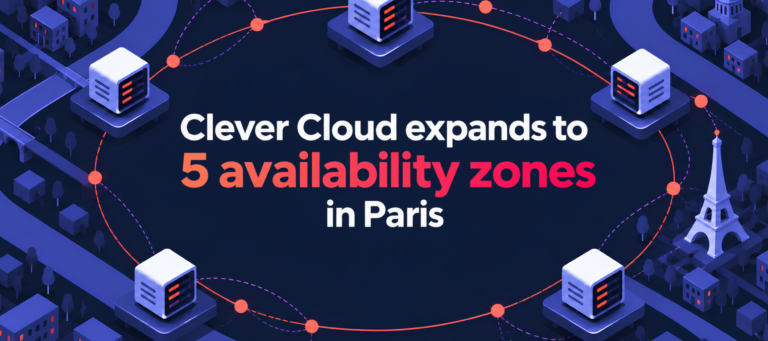
Clever Cloud’s selected announcements present three connected developments. The provider says it opened two additional availability zones at ETIX Paris #3 and Telehouse TH3, bringing its Paris region from three to five zones in 2026. According to Clever Cloud, distributed services with the appropriate replication and redundancy can now remain available after the simultaneous loss of two data centres, rather than one. At the application layer, it promotes Network Groups as a managed private-connectivity capability using encrypted WireGuard tunnels between applications, add-ons and, subject to current limitations, external machines. Its managed Keycloak offering extends this operational model to identity: Clever Cloud handles infrastructure, updates, monitoring and backups, while customers retain responsibility for realms, clients, users, permissions and authentication policies. The provider recommends OpenID Connect for new integrations where supported, while retaining SAML 2.0 for established enterprise software.
European control is becoming a full-stack proposition
Taken together, the developments indicate that Clever Cloud’s strategic direction is not simply to add French hosting capacity. It is assembling a European cloud proposition around physical distribution, infrastructure control and the managed operation of security-sensitive components. The choice of French server manufacturer 2CRSI and Finnish network supplier Nokia supports its stated autonomy agenda, while Network Groups and managed Keycloak move that agenda upward into networking and identity. A recurring design principle is to make operational complexity a platform responsibility: the provider orchestrates multiple sites, establishes encrypted private links and maintains Keycloak, rather than requiring customers to build those layers themselves. For Western European organisations, particularly those prioritising French data location and European supply chains, that combination may be more relevant than a sovereignty claim based on data residency alone. The selected material does not signal a distinct AI strategy; it instead shows current investment centred on resilient cloud foundations, access control and application operations.
Architecture still determines the protection achieved
The provider’s claims require careful qualification. Five availability zones do not automatically make every workload tolerant of two site failures: Clever Cloud itself conditions this outcome on the replication and redundancy mechanisms of the service concerned. The supplied material provides no independent failure-test results, latency measurements, capacity figures or detailed service-by-service availability mapping. Network Groups also do not remove existing public endpoints, so customers must separately prevent backend bypass and enforce appropriate access controls. Compatibility varies for older add-ons, and support for external peers was described as still being stabilised in testing. Centralising authentication through Keycloak can simplify MFA and policy enforcement, but it also makes identity infrastructure critical; token lifetime, logout propagation, realm design and application-specific authorisation remain customer concerns. The cited 99.99% SLA and round-the-clock telephone support apply through Clever Cloud’s Premium offering for eligible services, not automatically to every deployment. Buyers should therefore validate contractual scope, recovery behaviour and operational responsibility rather than infer them from the architecture alone.
Decision guide and Paris infrastructure source
For IT decision-makers in Western Europe, Clever Cloud merits consideration where French hosting, European infrastructure sourcing and reduced operational overhead are explicit requirements. The coherent element is the combination of multi-site Paris infrastructure with managed private networking and identity, but organisations should test whether their chosen services actually span failure domains, confirm how public exposure is disabled, and establish who owns backup restoration, identity policy and incident response. They should also compare the Premium support and SLA terms with their workload requirements and run failover and authentication tests before production adoption. The underlying provider material is available in the announcements on five Paris availability zones, private application networking with Network Groups and SSO configuration and managed Keycloak. These sources support a view of Clever Cloud as prioritising operationally managed, European-controlled cloud foundations, while the resilience and security outcomes still depend on customer architecture and the precise service contract.
