Sovereignty expands from data location to the operating chain
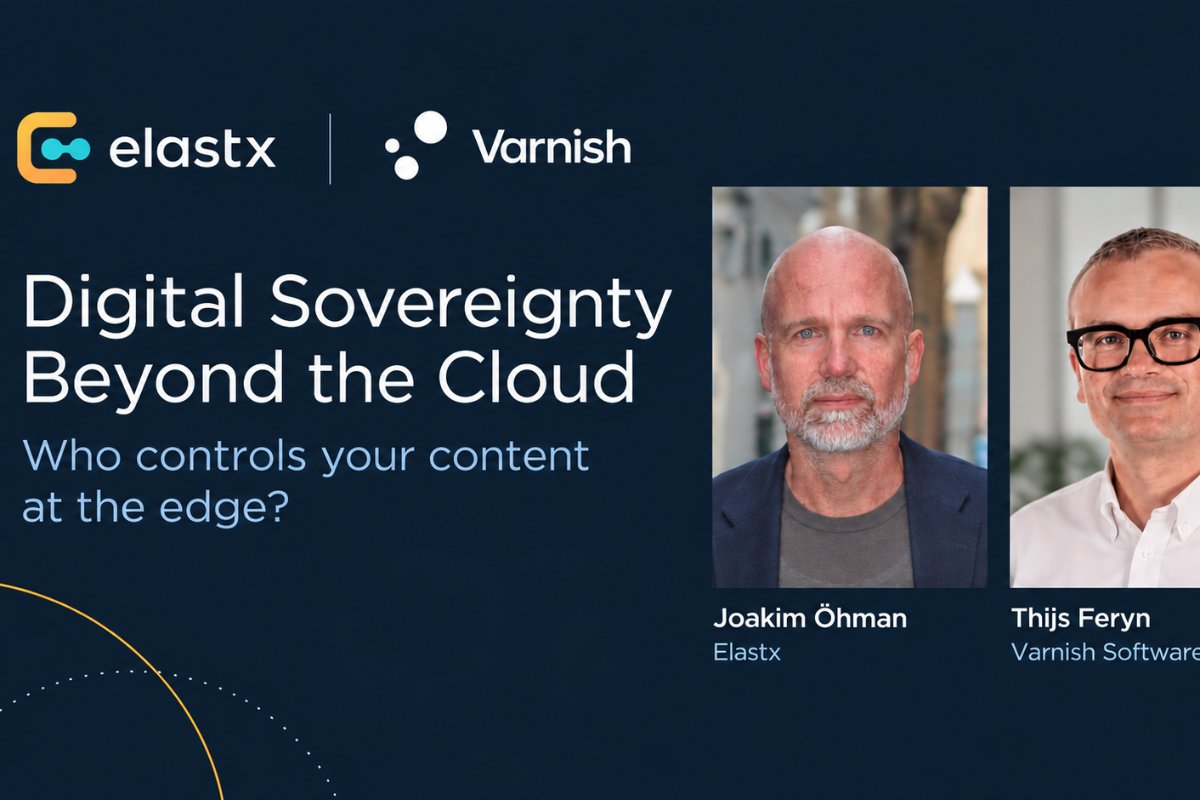
Three Elastx articles published in September 2026 present a common direction: European cloud control must encompass ownership, administration, software dependencies, AI models and the infrastructure between applications and users. Elastx argues that CDN and web application firewall services affect jurisdiction and control because they terminate TLS, process traffic, distribute content and protect applications. In a separate assessment, the provider applies the European Commission’s Cloud Sovereignty Framework and its SEAL 0–4 scale to itself. Elastx reports a self-assessed Sovereignty Score of 87% and an overall SEAL 3, while stating that its weaker areas include data and AI, operations, technology and supply chains. The company’s account of its software engineering practices adds an operational dimension: it says AI agents now write, test and review code in isolated sandboxes, can cooperate across codebases, and use both proprietary and open models. Elastx identifies Claude, Kimi and GLM among the models in use and says an increasing share of internal AI workloads runs on its own infrastructure.
A sovereign cloud strategy is becoming an architecture strategy
The emerging trend is that Elastx is treating sovereignty less as a data-residency feature and more as an architectural and operational discipline. Its priorities appear to be local control, open standards, transparent dependencies and the ability to change suppliers or models. The provider’s agent environment, internally called Boxen, illustrates this direction: agents reportedly operate in isolated environments with controlled access to shared code, infrastructure information and documentation for open-source technologies including OpenStack and Kubernetes. Elastx’s continued use of Claude alongside self-hosted open models suggests a pragmatic multi-model strategy rather than complete technological separation. For European organisations, the relevant strategic connection is that AI-assisted development can create a new layer of provider dependency just as CDN, WAF and remote administration already do. Elastx’s stated response is to retain model choice, move more workloads onto infrastructure it controls and develop an AI-based environment currently carrying the working name Elastx Code.
Promising operational claims still require buyer verification
The selected material is provider-authored, and several important claims are not independently validated here. The reported 87% score and SEAL 3 rating are explicitly a self-assessment, not evidence of external certification. Likewise, the account that a development pipeline previously taking a month can now be completed in a day is an individual operational example rather than a controlled productivity benchmark. Elastx says testing, reviews and release controls prevent AI mistakes from reaching production, but the articles do not provide incident rates, audit findings, model-evaluation results or detailed security controls for agent access. Nor do they establish how every CDN, WAF, model or underlying hardware dependency is governed. Buyers should therefore examine the weakest-link criteria behind the SEAL result, privileged-access locations, escalation procedures, model and data flows, software supply-chain controls, sandbox isolation and exit options. The articles themselves acknowledge a structural limit: complete European control remains difficult while processors, AI accelerators and other critical technologies originate outside Europe.
European buyer guidance and Elastx’s sovereignty assessment
For European IT decision-makers, Elastx’s direction is relevant because it connects procurement questions that are often assessed separately: cloud jurisdiction, edge delivery, administrative control, open-source infrastructure and AI development tooling. The provider’s Swedish and European-control proposition should not be accepted solely from data-centre location or a headline sovereignty score; it should be tested service by service and dependency by dependency. A useful evaluation would compare Elastx’s claims with contractual commitments, independent assurance and the organisation’s required SEAL level, while also determining whether multi-model portability and self-hosting materially reduce lock-in. The selected sources are Elastx’s discussion of sovereignty across CDN and WAF services, its self-assessment under the EU Cloud Sovereignty Framework, and its account of agent-based software development and multi-model AI operations. Taken together, they indicate a coherent strategy: Elastx wants sovereignty to become a verifiable operating model extending from cloud infrastructure to the edge and AI toolchain. The decisive buyer question is whether the provider can substantiate that model with controls and evidence appropriate to each workload’s risk.
